Why Adding a Ribbon to Your Suitcase Might Cause Travel Delays, According to Airport Experts
Introduction
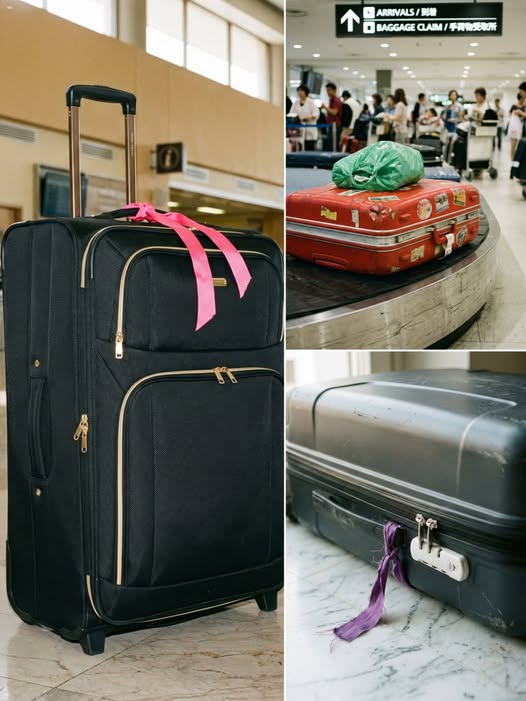
Anyone who has traveled by air is familiar with the moment of anticipation—and sometimes frustration—while standing at the baggage carousel. Dozens of nearly identical suitcases circle endlessly, and spotting your own bag can feel like searching for a needle in a haystack. To make identification easier, many travelers have adopted a simple trick: tying a colorful ribbon, scarf, or strip of fabric onto their luggage.
At first glance, this seems like a practical and harmless solution. A bright ribbon stands out, making your bag easy to recognize from a distance. However, airport professionals and baggage handling experts are increasingly cautioning against this common habit. What appears to be a clever travel hack may actually lead to delays, damage, or even lost luggage.
Understanding how modern baggage systems work reveals why small additions like ribbons can create unexpectedly large problems.
How Airport Baggage Systems Really Work
Behind the scenes of every airport is a highly sophisticated network designed to move thousands of pieces of luggage quickly and efficiently. Once you check in your suitcase, it begins a journey through an automated system consisting of conveyor belts, scanners, sorting machines, and loading equipment.
These systems are engineered for speed and precision. Bags are moved along belts, scanned by advanced barcode readers, and routed to the correct aircraft with minimal human intervention. Everything is optimized for uniformity—smooth surfaces, predictable shapes, and minimal external interference.
Because of this, even small irregularities can disrupt the process.
The Hidden Risk of Loose Attachments
When travelers attach ribbons, tassels, or scarves to their luggage, they introduce an element that these machines are not designed to handle. Unlike the rigid structure of a suitcase, fabric accessories are flexible and unpredictable.
Baggage handlers explain that loose items can easily become caught in conveyor belts or mechanical rollers. These systems often have narrow gaps where moving parts meet, and anything dangling from a bag can get pulled into these spaces.
When this happens, one of two outcomes is likely:
The ribbon is torn off, sometimes damaging the handle or zipper in the process
The bag becomes stuck, causing a temporary halt in the system
Even a single obstruction can create a ripple effect, delaying dozens—or even hundreds—of bags.
How Delays Happen in Real Time
Airports operate on tight schedules, and baggage systems are no exception. When a jam occurs, it must be cleared quickly to prevent further disruption. However, even short delays can have significant consequences.
If a bag is delayed in the sorting process, it may not reach the aircraft before loading is complete. This can result in the bag being left behind and sent on a later flight.
For travelers, this means arriving at their destination without their belongings—an inconvenience that can disrupt plans and cause unnecessary stress.
The Role of Barcode Scanning Technology
Another critical aspect of baggage handling is the use of barcode scanning systems. Each bag is tagged at check-in with a unique barcode that directs it through the sorting process.
Modern scanners are highly efficient, capable of reading codes in a fraction of a second. However, they rely on a clear, unobstructed view of the tag.