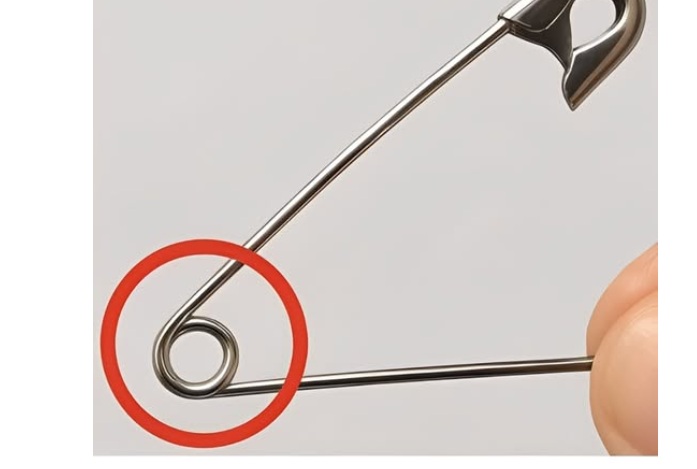
The Hidden Genius of Safety Pins: Uncovering the Secret Purpose of That Tiny Hole and Why This Everyday Tool Is a Masterpiece of Design and Functionality
It’s one of those tiny objects we encounter almost daily, yet rarely give a second thought: the safety pin. For decades, people have relied on it for emergency fixes—holding together a torn seam, securing a loose button, or even substituting for an impromptu piece of jewelry in a pinch. I’ve personally used them in all sorts of unexpected scenarios: fixing a broken zipper, patching a ripped hem, or even as a makeshift charm holder when nothing else was available. But like most people, I never paused to wonder about the small details of its design. Specifically, the little hole nestled at the base of its coil. I had assumed it was purely decorative, a quirk in an otherwise simple tool. Turns out, that tiny hole is anything but ornamental. It’s a small marvel of engineering, cleverly integrated to serve a purpose that makes the safety pin far more functional than most of us realize. And if you’re like me—like most humans—you probably never knew about it.
Let’s explore this often-overlooked detail and understand how something so small can make a big difference in both the design and functionality of the safety pin. Once you understand it, you’ll likely never look at a safety pin the same way again.
Understanding the Safety Pin at First Glance
Before diving straight into the mystery of the hole, it’s worth taking a moment to appreciate the ingenuity of the safety pin as a whole. At first glance, it seems like an extremely simple tool: a bent piece of wire with a sharp point on one end and a clasp on the other. Yet, this simplicity hides a remarkable amount of design thought.
The sharp end is obvious—it’s meant to pierce through fabric or material efficiently. The other end, where the clasp resides, is all about safety. This is precisely why the tool is called a safety pin: when closed, the sharp end is tucked neatly into the clasp, preventing it from poking or injuring the user. But nestled within this coil is the tiny, often overlooked hole. The shape and placement of this hole aren’t arbitrary; they are crucial for the tool’s functionality. The coil isn’t just there for aesthetics—it stores tension, which is essential for keeping the pin securely closed when not in use.
Without this tension, a safety pin could spring open unexpectedly, potentially causing injury or failing to hold materials together. That small coil, reinforced by the tiny hole, ensures stability, flexibility, and longevity, making the pin a quietly brilliant piece of everyday engineering.
So, What Exactly Is That Tiny Hole For?
Here’s where the story gets truly interesting. That small hole at the base of the coil isn’t a leftover from manufacturing or a decorative feature. Instead, it’s a fundamental part of the safety pin’s spring mechanism.
During production, the hole serves as an anchor point for the wire. The wire is threaded through this tiny opening as it’s coiled, which helps maintain consistent tension throughout the pin. Without this hole, the wire would not hold its tightly wound shape, and the spring would be far less effective. The coil might become loose over time, reducing the pin’s reliability and possibly causing it to fail when you need it most.
Essentially, the hole acts as a kind of “starting point” for the coil—a small but crucial anchor that ensures the tension in the spring is preserved. Every time you open and close a safety pin, the spring mechanism relies on this precise tension to allow smooth operation. The pin snaps back into place effortlessly because of the stability provided by the hole, demonstrating a level of design foresight that often goes unnoticed in such a humble tool.
The Engineering Behind the Tiny Hole
For those who love a little mechanical insight, the role of this hole is even more fascinating. Modern safety pins are produced using machines that shape the metal wire into a consistent, precise form. During this process, the hole functions as a guide, holding the wire in the correct position as it’s twisted into the coil. Without this anchor point, the manufacturing process would be far less reliable.
The hole also ensures uniformity across batches. Each safety pin, regardless of size or color, relies on this detail to maintain consistent tension. Without it, some pins might be too loose, while others could be overly stiff, resulting in a tool that either fails to close properly or risks bending the wire prematurely. In other words, the hole is a small but indispensable piece of precision engineering.
Spring mechanisms in many tools and devices use similar features during assembly. Whether it’s in clocks, small appliances, or fastening devices, anchor points during the coiling process are a standard engineering solution for maintaining reliable tension and torque. The safety pin, though simple in appearance, is no exception.
Common Misconceptions About the Hole
It’s easy to assume that the hole is purely decorative. After all, it’s tiny, unobtrusive, and doesn’t seem to serve a purpose unless you’re looking closely. Most people, myself included, never notice it. A pack of safety pins is typically opened in a rush, with users focused solely on fastening fabrics or materials. There’s no instruction card pointing out, “Attention: this hole is critical for spring tension!” It’s just part of the design we take for granted.
Yet, understanding the function of this tiny feature can change your perception. Safety pins are not just simple tools—they’re small feats of mechanical design, optimized for both functionality and reliability.
Unexpected Uses for the Hole
Interestingly, while the hole’s original purpose is structural, enterprising individuals have found creative ways to repurpose it. Some use the opening to thread ribbons or wires through, securing the pin to objects more effectively or preventing it from slipping during craft projects. Others loop thread through the hole in embroidery or sewing projects to anchor pins more precisely.