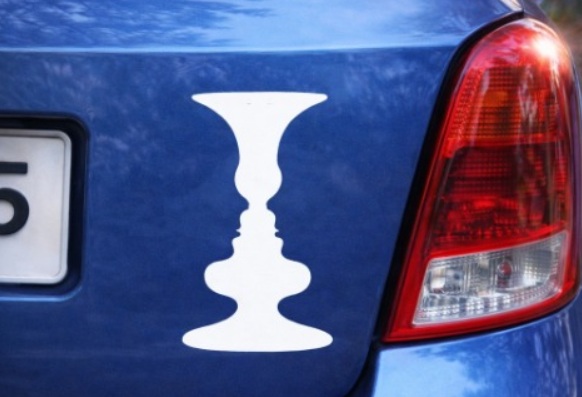
What Is the Symbol on the Back of the Car? A Clear Explanation of the “Faces or Vase” Design
At first glance, the white sticker on the back of the car may appear abstract or unfamiliar. Many people assume it is a brand logo, a cultural emblem, or even a custom graphic without a specific meaning. However, this symbol is not a company logo or a random design. It is a well-known visual figure from psychology and art, commonly referred to as the Rubin’s Vase.
Understanding what this symbol represents requires looking beyond its immediate appearance. While it may seem like a decorative sticker, it actually has a long history and a defined meaning rooted in the study of human perception.
The Origin of the Symbol
The image seen on the car is based on a classic visual concept introduced by Danish psychologist Edgar Rubin in the early 20th century. Rubin used this figure to demonstrate how human perception works when interpreting visual information.
The design consists of a symmetrical shape that can be interpreted in two distinct ways:
A central object resembling a vase or goblet
Two human profiles facing each other
This dual interpretation is not accidental. It is carefully constructed to illustrate how the human brain processes figure and background within a single image.
Although the image is often discussed as an illusion, it is more accurately described as a perceptual figure used in psychology. The purpose of the design is not to trick the viewer, but to reveal how perception shifts depending on focus.
What the Symbol Actually Represents
The symbol represents a concept known as figure-ground perception. This is a fundamental principle in visual cognition that explains how people distinguish an object (the figure) from its surrounding area (the ground).
In this design:
If the white area is perceived as the figure, the viewer sees a vase
If the white area is perceived as the background, the viewer sees two faces
The brain cannot fully prioritize both interpretations at the same time. Instead, perception alternates between them.
This is why the symbol is widely recognized in academic contexts. It demonstrates that visual perception is not fixed, but dynamic and influenced by attention.
Why It Appears on a Car
The use of this symbol on a car is primarily decorative, but it also serves a communicative purpose. People choose this design for several reasons:
Visual Interest
The symmetrical and minimalistic shape makes it visually appealing. It stands out without being overly complex.
Intellectual Appeal
Because the design has a known psychological background, it can signal curiosity, creativity, or interest in perception and design.
Conversation Value
The symbol often prompts questions. People who are unfamiliar with it may ask what it represents, which naturally creates engagement.
Unlike commercial logos, this symbol is not associated with a specific brand or product. Its presence on a vehicle is typically a personal choice rather than a promotional one.
Not a Brand or Organization Logo
One important clarification is that this symbol is not tied to any company, institution, or official organization. It does not represent a manufacturer, a political movement, or a membership group.
This distinguishes it from many other car decals that often indicate:
Automotive brands
Sports teams
National or regional identities
Social or political affiliations
In contrast, this design belongs to the public domain of visual concepts and educational imagery.
Use in Design and Education
The symbol has been widely used in various fields beyond psychology:
Graphic Design
Designers use it as an example of how negative space can create multiple interpretations within a single composition.
Education
It is frequently included in textbooks and lectures to explain how perception works.
Marketing and Media
Because it captures attention quickly, it is sometimes used in advertising or visual storytelling.
Despite its simplicity, the design remains relevant because it effectively demonstrates a complex idea in a clear visual form.
Why It Is Often Misunderstood
Many viewers who encounter this symbol outside of an educational context do not immediately recognize it. This leads to common misunderstandings, such as:
Assuming it is a stylized object or abstract art
Believing it represents a specific cultural symbol
Thinking it is a newly created or trending design
In reality, the symbol has existed for over a century and has a well-documented origin.
The confusion arises because the design does not include text or recognizable branding. Its meaning is entirely visual, which makes it open to interpretation for those who are unfamiliar with its background.
The Role of Perception in Interpreting the Symbol
What makes this symbol particularly significant is how it reflects the way people interpret visual information in everyday life.
Perception is not a passive process. The brain actively organizes and interprets sensory input based on context, focus, and prior experience.
With this symbol:
Some viewers immediately recognize the faces
Others initially see only the vase
Some may not notice the second interpretation until it is pointed out
This variation highlights that perception is subjective, even when viewing the same image.
Why It Continues to Be Used Today
The continued use of this symbol in modern contexts, including car decals, can be attributed to several factors:
Timeless Design
The simplicity and symmetry of the image allow it to remain visually effective across different settings.
Universal Meaning
The concept it represents is not tied to a specific culture or language, making it widely understandable once explained.
Subtle Complexity
It appears simple at first but reveals deeper meaning upon closer examination.
These qualities make it suitable for both educational and decorative purposes.
Conclusion
The symbol on the back of the car is not a brand logo or a random graphic. It is a well-established visual figure known as Rubin’s Vase, created to illustrate how human perception distinguishes between figure and background.
Its presence on a vehicle is typically a personal design choice rather than a statement of affiliation. While it may initially seem unclear or ambiguous, it has a clear origin and a defined meaning within the fields of psychology and visual design.
Understanding this symbol provides insight into how perception works and why certain images can be interpreted in more than one way. What appears to be a simple sticker is, in fact, a representation of a fundamental concept in how people see and understand the world.