Understanding the Fallstreak Hole Phenomenon: A Clear, Science-Based Explanation of One of the Sky’s Most Striking Displays
The sky is one of the most familiar sights in human life, yet it never truly becomes ordinary. Every day, clouds shift shape, light changes direction, and the atmosphere creates patterns that can feel both calming and mysterious. Sunrises and sunsets paint warm colors across the horizon, while storm clouds build dramatic structures overhead. Most of the time, these changes are subtle enough to go unnoticed unless we are actively looking up.
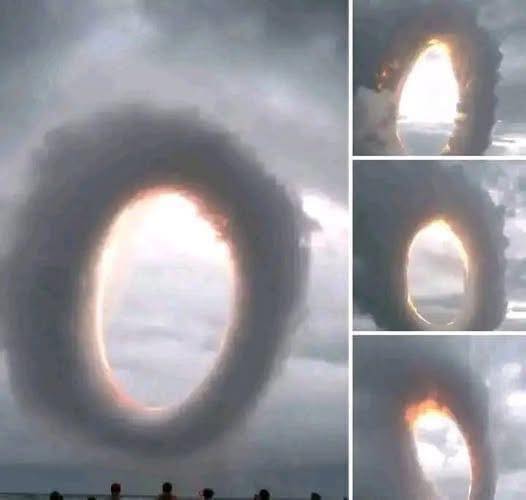
But occasionally, something appears that immediately captures attention—something unusual enough to make people stop, point, and take photographs. One such atmospheric event is known as a fallstreak hole, also commonly referred to as a hole-punch cloud.
At first glance, it may look artificial, almost as if a perfectly round opening has been cut into the sky. Some people describe it as a “window” through the clouds or even a “tear” in the atmosphere. Beneath this opening, faint streaks of cloud often appear to fall downward like delicate curtains.
Despite its dramatic appearance, a fallstreak hole is not a supernatural sign or a mysterious anomaly. Instead, it is a fully natural meteorological phenomenon that scientists understand well. It is a beautiful example of how complex and delicate atmospheric processes can create visually stunning results.
In this article, we will explore what fallstreak holes are, how they form, why they look the way they do, and what they reveal about the physics of our atmosphere.
What Is a Fallstreak Hole?
A fallstreak hole is a large, circular or oval-shaped gap that appears in a cloud layer, usually within mid-level clouds such as altocumulus clouds or cirrocumulus clouds.
These clouds are made up of tiny water droplets that often exist in a special physical state known as supercooled liquid water.
Understanding Supercooled Water
Under normal conditions, water freezes at 0°C (32°F). However, in the atmosphere, water droplets can remain in liquid form even when temperatures drop well below freezing. This happens because the droplets are extremely small and lack a “trigger” to start the freezing process, such as dust particles or ice nuclei.