The Neighbor’s Warning
When I got home that Wednesday afternoon, my neighbor, Mrs. Halvorsen, was already waiting for me. She stood on her porch with her arms folded tightly over her chest, her expression carrying that familiar mixture of irritation and concern she reserved only for me—and for stray cats that dared wander across her lawn.
“Your house gets so loud during the day, Marcus,” she called out before I even stepped out of my car. “Someone was shouting in there again today. A man. Very loud. It scared me.”
Her accusation hit me like a bucket of cold water.
“That’s impossible,” I said, forcing a polite smile as I lifted my grocery bags from the trunk. “I live alone. And I’m at work all day.”
She tightened her mouth. “Well, someone’s in there. I knocked twice. Loudly. No one answered, but the shouting continued for a few seconds before stopping completely. I know what I heard.”
A strange prickling sensation crawled across my skin. I wanted to assume she was mistaken—she was 73 and sometimes confused her TV for real life—but something in her eyes made me hesitate. She wasn’t exaggerating. She was afraid.
But admitting that would mean opening a door I wasn’t ready to open.
“It was probably the TV,” I said quickly. “I leave it on sometimes. You know, to deter burglars.”
She shook her head, unconvinced. “This wasn’t a TV. The house has been… strange lately. Different.” Then she lowered her voice, adding, “Just be careful, dear.”
I nodded, though inside a knot was tightening.
As I walked up my driveway, the late-afternoon air felt unnaturally still. Even the wind seemed to avoid my house. When I unlocked the front door and stepped inside, a chill greeted me—not a coldness from temperature, but something deeper, something that felt like a presence withdrawing, retreating into the walls. Like the house had been holding its breath.
I placed the grocery bags on the kitchen counter and moved through the rooms slowly, scanning every detail. Everything was exactly where I left it. No open windows. No sign of forced entry. No smell of unfamiliar cologne or sweat. Nothing out of place. Nothing missing.
Except the house itself felt wrong… heavier somehow.
I told myself I was being paranoid. That night, I tried to ignore the dull ache of anxiety and forced myself into bed. But I barely slept. Every creak, every shift of the house, every whisper of wind outside made my pulse race. At 3:17 a.m., I was still awake, staring at the ceiling, thinking about a stranger yelling inside my home while I wasn’t there.
By morning, I had made a decision.
One that would change everything.
Under the Bed
At 7:45 a.m., I opened the garage door, got into my car, and pulled out just far enough for the neighbors to see. Then I switched off the engine, coasted silently back inside, and shut the garage door again. My heart was beating fast, adrenaline pulsing.
I wasn’t going to work today.
Today, I was going to find the truth.
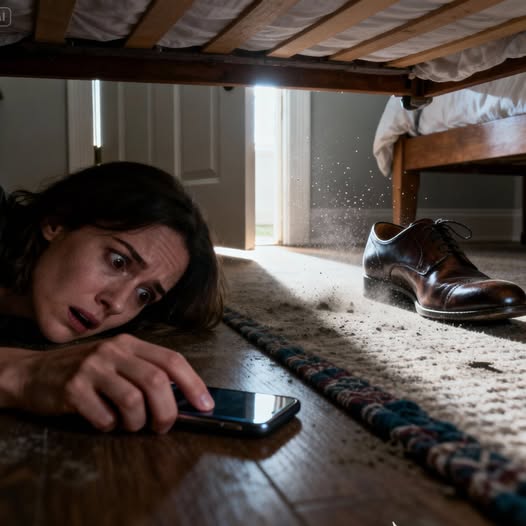
I entered the house through the side door as quietly as possible, every footstep deliberate. The morning sunlight leaked through the blinds, casting thin lines across the floor. I moved quickly to the bedroom, climbed onto the mattress, and slid underneath it, pulling the comforter down behind me so no one could see me from above.
The hardwood floor beneath me was cold.
My heart thudded painfully in my chest.
For a long time, there was nothing but silence and the sound of my own ragged breathing. Minutes bled into hours, and doubt began to creep into my thoughts.
What if nothing happened?
What if my neighbor had imagined everything?
What if I had called out of work for nothing?
But at exactly 11:20 a.m., the front door opened.
Slow. Careful.
My pulse slammed against my ribs.
Footsteps followed—steady, unhurried, with a casual confidence that made my blood run cold. They moved down the hallway with the easy familiarity of someone who knew every creak, every board, every turn.
Someone who had been here before.
Then the footsteps entered my bedroom.
My lips parted in a silent gasp.
A man’s voice—low, irritated—muttered,
“You always leave such a mess, Marcus…”
My body went weightless.
He knew my name.
His tone wasn’t anxious or rushed. It wasn’t even hostile. It was the voice of someone who felt entitled to be annoyed—like a roommate, or a brother, or someone who knew me intimately.
My heart hammered so loudly I feared he would hear it. His boots moved around the room, lazy but purposeful. Papers shifted on my dresser. A drawer opened and slammed.
“You always hide things in different places, Marcus…” he whispered.
My skin crawled.
Dust coated my throat as I breathed shallowly. I needed to see him. Without thinking, I shifted, inch by painful inch, until I could see beyond the edge of the comforter.
He walked to the closet, sliding the door open. Clothes hangers rattled.
His boots came into view.
Brown leather. Creased but polished. Worn by someone who walked a lot. Worked a lot. Lived hard.
Not the shoes of a sneak thief.
The shoes of someone with history.
Suddenly, my phone vibrated in my pocket.
The faint hum might as well have been a gunshot.
The man froze.
Slowly… very slowly… he crouched.
His boot tips turned toward me.
Then… fingers curled around the comforter.
And began lifting.
My body reacted before my mind did—I rolled out the opposite side of the bed, scrambling to my feet. The man lunged after me, knocking a lamp to the ground with a violent crash. I backed away, breath shaking, grabbing the lamp by its base like a weapon.
He straightened.
And that’s when I saw his face for the first time.
He looked like me.
Not identical, but undeniably similar—jawline, eyes, even the small scar near the corner of the eyebrow. Like a version of me molded by a different life. A harder life. His gaze was sharp but familiar, and his expression carried something between irritation and resignation.
“You weren’t supposed to be here,” he said calmly.
My voice cracked. “Who the hell are you?”
He raised his hands in a gesture of peace. “My name is Adrian.”
“How do you know my name?” I demanded.
His response was so quiet, so controlled, it chilled me more than shouting ever could.
“Because I didn’t plan for you to find out like this.”
The Brother in the Walls
For a moment, neither of us moved.
I stood gripping the lamp tightly with both hands, my breath loud and unsteady. Adrian stood on the other side of the bed, hands lifted as though faced with a skittish animal. His chest rose and fell steadily, too calmly, like he had rehearsed this moment a thousand times and was waiting for the right line to deliver.
“You shouldn’t be here,” he repeated softly.
“I live here,” I snapped, voice cracking. “Who are you, and what the hell are you doing in my house?”
His eyes flickered to the floor before meeting mine again. “I didn’t want this to happen like this. I didn’t want to scare you.”
“You’re inside my bedroom,” I said, lifting the lamp higher. “You’re going to need to try a hell of a lot harder than that.”
He exhaled slowly, as if steadying himself. “Look… my name is Adrian. And I know you’re Marcus. I know a lot about you.”
“That’s not helping your case.”
“I’m not your enemy,” he said. “I’m your brother.”
The world tilted.
For a moment, I genuinely thought I misheard him. A ringing filled my ears, drowning out the room, the dust, the light, everything. My grip on the lamp tightened until my fingers ached.
“My father had no other children,” I said coldly.
Adrian lowered his hands but stayed still. “That’s what you were told.”
“My father died when I was nineteen,” I snapped. “I would know if he had another family.”Family games
He nodded slowly. “He died for me too.”
Something inside me cracked—part fear, part nausea, part something deeper, older, buried.
“Stop talking like you knew him.”
“I did know him,” he replied, voice cracking for the first time. “He raised me until I was six. After that… he disappeared from my life. Just vanished. I spent years not understanding why. Years thinking I did something wrong.”
I felt my throat constrict.
“You expect me to believe that?”
“No,” he said quietly. “Which is why I brought these.”
He reached for the blue box he’d taken from my closet. I tensed, ready to strike, but he moved slowly, deliberately, showing me his hands. He opened the box and slid it across the bed toward me.
Inside were letters.
Dozens of them.
My father’s handwriting.
My breath hitched.
The shaky loops in the signature. The slanted R’s. The way he always crossed his T’s with a long, sweeping line that nearly looked like a second word.
This handwriting lived in my memory like a ghost.
I reached out before I could stop myself. My fingers brushed the top letter—addressed not to my mother, as I expected—but to a woman named Elena Keller.Moving Services
My stomach dropped.
I opened the first letter with trembling hands.
Elena,
I am trying. God knows I am trying. But my life is split clean down the middle—two worlds, and I belong fully to neither. I wish I could be the father Adrian deserves. I wish I could give him more. I wish I could be enough for both of my families.
Maybe one day, Marcus will understand too. Maybe he’ll forgive me.
The room spun.
My father never wrote poetically. He was blunt. Practical. But this letter—this agony—felt real. The kind of confession he never spoke aloud.
I flipped to another letter.
And another.
Each one a small wound peeling open.
A hidden relationship.
A second life.
A child.
A son.
A brother.
I stared at Adrian. The resemblance I tried to deny earlier now screamed at me—shared bone structure, similar mouth, the same slight curve in the left ear we both inherited.
“This… this doesn’t make sense,” I whispered, voice trembling.
Adrian’s expression softened—not with triumph, but with relief. Like carrying this truth had exhausted him for years.
“It wasn’t supposed to be like this,” he said. “I wasn’t supposed to come here.”
“Then why did you?” My voice sharpened again. “Why sneak into my home instead of talking to me like a normal human being?”
His jaw clenched. “Because I didn’t think you’d believe me. No one else did.”
I swallowed hard. “How long have you been living here?”
He hesitated. “On and off… about five months.”
My chest tightened. “Five months? You’ve been inside my home—for five months?”
“Not every night,” he said quickly. “Only during the day. When you’re gone. I never wanted to scare you.”
“But you did,” I snapped. “You scared me more than anything in my life.”
He closed his eyes briefly. “I didn’t have anywhere else to go. I lost my job. My apartment was broken into twice. I was sleeping in my car. I tried reaching out to relatives, but no one believed I was his son. They thought I was lying to get money.”
“So you decided to break into my house?”
“I didn’t break in.” His voice was steady. Too steady. “I had a key.”
Cold horror poured through me.
“How?” I whispered. “Where did you get a key to my house?”
He looked at me with something like pity.
“From our father.”
“My father died before I bought this house,” I said. “He never even saw it.”
Adrian’s eyes darkened. “He left it with someone. Someone who was supposed to give it to me when the time was right.”
A chill spread through me. “Who?”
He didn’t answer.
Instead, he said quietly, “I only ever wanted to be close to something that belonged to him.”
A silence settled between us—thick and suffocating.
I still held the lamp. My arm ached from the weight, but I didn’t dare lower it.
“I’m calling the police,” I said finally.
Adrian didn’t flinch. Instead, a faint, strange smile curved his lips.
“You won’t,” he murmured.
“Try me.”
“That’s not who you are,” he said gently. “And besides…” he tilted his head, studying me in a way that made my skin crawl, “you’re not angry enough.”
“What is that supposed to mean?”
“You’re not afraid enough either.”
My pulse spiked.
A new kind of fear slithered up my spine.
Because suddenly—
I realized something horrifying:
He wasn’t nervous.
He wasn’t desperate.
He wasn’t broken.
He was comfortable here.
Too comfortable.
As if everything so far… had been the beginning.
Not the end.
The House That Was Never Mine
For several long seconds, neither of us spoke. The room felt smaller, the air thicker, as though the walls themselves were listening. Adrian’s eyes never left mine—steady, eerily steady. I could feel the lamp trembling in my grip, not because it was heavy, but because something inside me was beginning to unravel.
“I don’t understand what you mean,” I said quietly. “Why wouldn’t I be angry? Why wouldn’t I be afraid?”
Adrian tilted his head slightly, studying me like a puzzle. “Because some part of you already knew.”
My mouth went dry. “Knew what?”
His gaze drifted across the room—to the closet, the dresser, the window, the bed. Not chaotically. Not searching. Familiar. As if he had lived in this room longer than I had.
He walked slowly toward the nightstand.
“Don’t move,” I warned.
But he only picked up a small photograph in a frame—one I’d barely noticed in months. A picture of me at twenty-one, holding my father’s old pocket watch.
“You think your life began when he died,” Adrian said softly. “But there were things he never told you. Things he left behind. Things he left me.”
I tightened my grip on the lamp. “I want you to leave.”
“I will,” he said. “But I need you to listen first.”
He set the photo back down with a gentleness that made my stomach twist. Then he moved toward the hallway.
“Don’t go anywhere,” I snapped.
He paused at the doorway and looked back. “Do you want answers or not?”
I hesitated. That was all he needed. He stepped into the hall, and I followed, lamp raised, heart pounding.
As I entered the hallway, I felt something unnerving—something I had never consciously noticed before:
The faint smell of coffee.
Not the fresh morning brew I made sometimes.
A different scent.
Stronger.
Older.
Like someone had made it earlier that day.
My skin crawled.
Adrian glanced back at me. “Do you smell it?”
“Stop,” I warned. “Stop talking like you belong here.”
“But I do,” he said quietly.
He turned into the guest room—the one no one ever used. The one I kept closed most of the time. He walked to the window and pointed to the sill. There were faint scratches—thin, overlapping lines that looked like something had been dragged back and forth over time.
I never saw those before.
Or maybe I never looked.
“I stayed here during the first weeks,” Adrian said. “The bed was too soft. You sleep too lightly at night.”
My stomach churned violently. “Stop saying things like that.”
“You want the truth, Marcus. I can see it in your face. You’ve always wanted it.”
“I want you out of my house.”
“It’s not your house,” he whispered.
Something inside me cracked open.
“What do you mean it’s not my house?”
“Your father bought it,” he said simply. “For me.”
The world spun.
“No,” I whispered. “I bought this house. With my own money. I signed the papers myself.”
Adrian nodded. “Yes. On paper, it’s yours. But the down payment? The fund you thought came from your grandfather’s inheritance? It didn’t. It came from him.”
“That’s impossible,” I said, shaking my head. “My father never had that kind of money. And I didn’t even know this house existed when he died.”
“He planned it years before,” Adrian said. “He wanted us to live here together. When we were older. When he could bring us together properly.”
My breath caught in my throat.
“He called it The Meeting Place,” Adrian continued. “The home where his two sons would finally know each other.”
He said it with such certainty, such quiet conviction, that for a moment I couldn’t breathe.
“He died before he could tell you.”
“He died before he could bring me back.”
“He died before he could give me the key.”
The words echoed in my mind like footsteps in an empty house.
“He didn’t leave instructions for any of this,” I said, voice trembling. “If what you’re saying is true, why didn’t my mother know? Why didn’t I know? Why didn’t anyone say anything?”
“Because he didn’t want them to,” Adrian said. “He didn’t want anyone interfering.”
I swallowed hard. “Interfering with what?”
His eyes darkened. “With us.”
My heart skipped a beat.
He stepped closer.
“You never wondered,” he said softly, “why you walk through this house like a visitor? Why you sit in certain rooms but avoid others? Why you never spend time in the kitchen before noon, or why you sleep only on one side of the bed even though there’s plenty of space?”
I backed away instinctively. “Stop.”
“You feel it,” he said. “The house wasn’t shaped for you. You don’t fit its rhythm. But I do.”
Every word twisted deeper, sharper.
“That’s why you’re not as scared as you should be,” he went on. “Because deep down… you always felt someone else lived here.”
I stared at him, heart pounding, mind racing.
But then—
He said something that nearly stopped my breath:
“Do you want to see where I stayed before I used the guest room?”
I didn’t answer.
He didn’t wait.
He walked past me, down the hall, down the stairs. I followed, unable to stop myself.
He reached the basement door.
My basement.
A place I rarely entered.
He opened the door slowly.
A cold, damp draft brushed my face.
He descended the steps confidently, without needing the light.
I turned on the switch and followed him down—
And the moment my feet hit the concrete floor—
I stopped breathing.
Because in the corner, behind old storage boxes and covered with a blanket, was a small mattress.
Blankets.
A pillow.
A half-empty water bottle.
And next to it—
A photograph of my father.
And two boys.
One of them was me.
The other was Adrian.
I felt the world tilt.
“I lived down here first,” he said quietly. “Before I knew where you kept the spare key. Before I started coming upstairs. Before I learned your schedule.”
I staggered back.
“I don’t want to hear another word,” I whispered. “I want you to leave. Now.”
He turned toward me slowly.
His voice dropped—calm, certain, chilling.
“I can’t leave, Marcus.”
“Why not?” I choked out.
He stepped closer.
“Because this house isn’t just where I lived…”
His eyes locked onto mine.
“…it’s where I died.”
The basement lights flickered.
And everything inside me turned to ice.
Kyle turned his head slightly toward his mother, his eyelids still heavy, his body exhausted from everything it had endured. Sharon’s breath caught in her throat, as if she’d been waiting for this one moment to decide whether she was allowed to keep breathing at all.Moving Services
“Mom?” His voice was thin, rough, but real.
Sharon pressed both hands to her mouth. “I’m here,” she whispered, stumbling toward the bed. Her knees almost gave out, but she steadied herself at the railing. “Baby, I’m here.”
Kyle blinked slowly, his gaze drifting between us as if trying to gather scattered pieces of a dream. “Did I… did I do something wrong?”
That question split Sharon in half. I saw it, the way her face twisted, the way panic and guilt surged through her like a wave that nearly crushed her.
“No,” she cried, shaking her head so violently it made her hair stick to her cheeks. “No, sweetheart. You didn’t do anything wrong. Nothing. This was… this was Mommy’s fault.” She looked down, ashamed. “I should’ve been with you.”
Kyle’s fingers tightened weakly around mine.
“It’s okay,” he murmured, not understanding the weight of anything, just wanting peace. “I’m okay.”
Sharon broke then—really broke. Not the silent tears from earlier, not the trembling jaw or glassy eyes. This was the kind of sobbing that came from the center of a person, as if grief was clawing its way out. She covered her face, shoulders shaking violently.
I instinctively reached toward her, hesitated, then rested a hand on her back. She leaned into me as though she’d been waiting years for someone to steady her.
“I can’t keep living like this,” she whispered between sobs. “I’m losing him. I’m losing myself. I don’t even know who I am anymore.”
My voice was soft, but firm. “Then change it. Not tomorrow. Not someday. Now.”
She lifted her head, eyes swollen, but searching. “Do you think I can?”
I looked at Kyle—pale, exhausted, but alive—and then at my sister, raw and stripped down to her truest self.
“I think,” I said slowly, “that this is your wake-up call. The kind that doesn’t come twice.”
A silence fell over the room, but not the heavy kind. This one felt… open. Like the world had shifted just a little, making space for something new.
Kyle drifted back to sleep, still holding my hand, and Sharon sank into the chair beside him. She stared at him for the longest time, her expression softening into something vulnerable and hopeful—an expression I hadn’t seen from her in years.
“I want help,” she said quietly, without looking at me. “Real help. I’m done pretending I’m fine.”
I placed my hand over hers. “Then we start today.”
She nodded, tears sliding silently down her cheeks. “I just… I can’t lose him. I can’t.”
“You won’t,” I said, meaning every word. “Not if you choose differently from this moment forward.”
Outside the window, the first thin streaks of morning light stretched across the sky, reaching delicately into the room. It felt symbolic, almost too on-the-nose—but maybe real change is supposed to arrive exactly like that, in quiet dawn moments after the darkest night.
Sharon inhaled deeply, steadying herself for whatever came next.
And I knew—with a strange, fierce certainty—that the story wasn’t ending here.
It was turning.
The Breaking Point
The hospital discharged Kyle two days later. He was groggy, moving slowly, with the kind of fatigue that makes a child suddenly seem older. But he was okay. And okay, at that moment, felt like a miracle.
Sharon and I rode with him in the back seat of my car. He leaned against me, wrapped in a blanket I kept for emergencies—the soft, faded blue one he always said “smelled like safety.” Sharon stared out the window, hands clasped so tightly her knuckles had turned white. She wasn’t crying. She was thinking, which for her was far more dangerous.
When we pulled into the driveway, Kyle whispered, “Can I sleep on your couch, Aunt Brenda? Just tonight?”
“Of course,” I said, brushing a hand over his hair. “You can sleep anywhere you want.”
Sharon stepped out of the car slowly, as if every movement hurt. When Kyle went inside, she turned to me.
“I need to tell you something,” she said.
Her voice was too calm—too level. The kind of calm that comes before a confession.
“I don’t trust myself,” she admitted. “Not as a mother. Not as a person. Not right now.”Moving Services
She paused, swallowing hard.
“And I think the best thing I can do for Kyle… is to let you take care of him for a while.”
My heart clenched painfully. “Sharon—”
“No. Listen.” Her eyes filled, but she didn’t look away. “I love him. God, I love him more than anything. But love isn’t enough when you’re drowning.”
Her voice cracked.
“I don’t want him to grow up thinking he wasn’t worth choosing. So I’m choosing him. I’m choosing to step back and get help.”
The air seemed to hold still between us.
I had spent years imagining ways to protect Kyle from Sharon’s chaos. But I had never once imagined she would be the one to say she couldn’t do it alone.
“I’ll help you both,” I said finally, and the words felt like a vow. “Whatever it takes.”
She nodded, a single tear rolling down her cheek. “Thank you.”
Then, after a long, shaky breath:
“Please don’t let him think I abandoned him.”
“You’re not abandoning him,” I said, pulling her into a tight hug. “You’re fighting for him.”
She clung to me like someone who had spent years falling and had finally grabbed onto something solid.
THE ENDING — One Year Later
Winter arrived early that year. Snow dusted the town like powdered sugar, settling on rooftops and fences, turning every street into something gentle and quiet. Kyle loved it—he said the snow made everything feel “new,” which was fitting.
He was sitting at the kitchen table, building a crooked little snowman out of clay for a school project. The smell of hot cocoa filled the apartment. His laughter—light and unburdened—drifted through the room like a small miracle.
I watched him with a kind of gratefulness I couldn’t have imagined a year ago.
We had settled into a rhythm, he and I. Homework after school. Reading together at night. Saturday morning pancakes. His drawings taped crookedly on the fridge. And on Sundays, when the weather was good, we’d walk in the park, where he would always try to skip rocks—even when the lake was frozen.
He was safe. He was steady. He was growing.
And Sharon?
She was healing.
She checked herself into a recovery program just days after that hospital night. Not the quick, surface-level kind, but the long, painful, soul-grinding kind where you confront everything you’ve been running from. She made mistakes, but she kept going. She missed Christmas with Kyle, missed his spring recital, missed his eighth birthday. And yes—some days he cried about it.
But then, around midsummer, she began calling regularly. Then visiting—supervised at first, awkward and fragile, but real. She brought small drawings she’d made in therapy, each one representing something she’d learned about herself. Kyle didn’t fully understand their meaning, but he stuck them to the fridge anyway.
The day she completed the program, she called me crying so hard I could barely understand her. Not the old kind of crying—this time it came from a place of release.
She was trying. Slowly. Honestly.
And Kyle was starting to trust her again, in his own time, his own way.
THE FINAL SCENE
It was the first snow of December when Sharon knocked on my door. Kyle ran to answer it, his socks slipping across the wood floor. When he opened the door, the cold rushed in—sharp, clean, full of possibility.
Sharon stood there holding a box of gingerbread cookies she had baked herself, her hands shaking just a little.
“Hi,” she said softly.
Kyle stared at her for a moment, his eyes searching her face the way children do when they’re trying to read a truth adults often hide.
“Mom?” he said quietly.
“Yes, baby.”
“Are you… staying this time?”
Sharon’s breath stuttered. She knelt so she was eye-level with him.
“I’m staying,” she whispered. “For good. And I’m better now. Not perfect… but better. And I’m never giving up again.”
Kyle thought about that for a long moment.
Then, without warning, he launched himself into her arms.
She gasped, clutching him tight, tears streaming down her face as the snow fell softly behind them. I stood in the doorway, watching them, warmth spreading through me like sunlight melting ice.
Everything wasn’t perfect. It would never be perfect.
But it was real. And it was enough.
Sharon lifted her head and looked at me over Kyle’s shoulder, gratitude shimmering in her eyes.
“Thank you,” she mouthed.
I nodded.
Some stories don’t end with a miracle.
Some end with a choice.
With a single decision to do better, be better, try again.
And sometimes—that’s the most powerful ending of all.
The End.