“Even with Everyone Online Trying, Less Than 10 Know the Answer”
“Even with Everyone Online Trying, Less Than 10 Know the Answer”
Posted onApril 6, 2026 ByadminNo Commentson “Even with Everyone Online Trying, Less Than 10 Know the Answer”
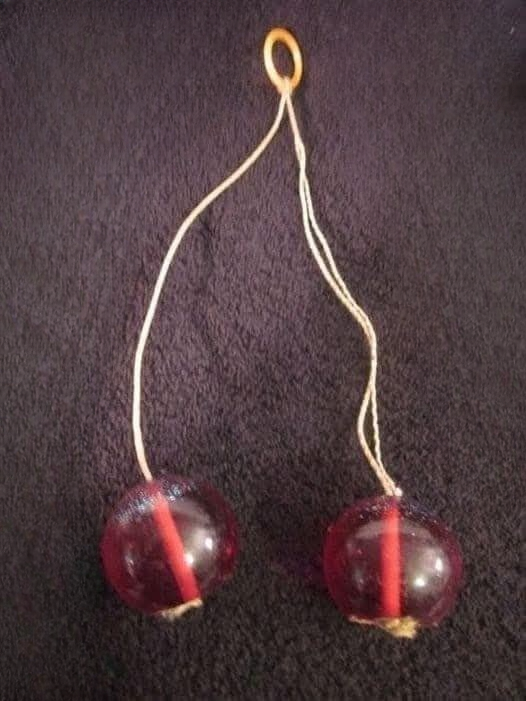
In an era dominated by digital screens, video games, and virtual reality, it is almost hard to imagine a toy capable of capturing the collective attention of an entire generation using nothing more than the simplest materials: two plastic spheres and a string. Yet in the late 1960s and early 1970s, one particular toy achieved precisely that. Known as Clackers—or sometimes “Lik-Klaks,” depending on regional marketing—the toy became both a cultural phenomenon and a fleeting symbol of childhood ingenuity, skill, and competitive spirit. Today, nearly ninety percent of those who encounter a Clacker for the first time are utterly baffled, staring at the unassuming device and wondering how it ever became so popular.
To truly understand the magnitude of Clackers’ impact, it is essential to examine their design, origins, cultural reach, and eventual decline, all in depth. Beyond the apparent simplicity of a string and two plastic balls lies a story of skill, danger, creativity, and nostalgia that resonates with lessons far beyond mere play.
The Design and Mechanics: Simple, Yet Deceptively Complex
At first glance, Clackers appear ordinary. They consist of two rigid plastic spheres—approximately the size of a small fist—connected by a single string. A small ring or handle in the center of the string allows the player to manipulate the toy. When swung rhythmically, the spheres collide above and below the player’s hand, producing a sharp, rapid-fire “clack-clack” sound that could be heard from blocks away.
The apparent simplicity is deceptive. Timing, coordination, and rhythm are essential to master the toy. Novices often ended up with bruised fingers, entangled balls, or repeated frustration as the spheres bounced unpredictably. Skilled players, however, developed precise techniques that allowed intricate patterns, rapid sequences, and performances admired by peers.
The charm of Clackers was therefore twofold. First, they engaged players physically, requiring coordination, hand-eye precision, and muscle memory. Second, they offered immediate auditory feedback—a rewarding “clack” that signaled success. In this way, Clackers were not just toys, but tools for practice, performance, and social interaction. The rhythmic resonance of the spheres became a soundscape of childhood, echoing across playgrounds and neighborhood streets.
The Birth of a Craze: Wham-O’s Influence
The Clacker phenomenon can be traced directly to Wham-O, the American toy company responsible for some of the most iconic playthings of the 20th century. Founded in 1948 by Richard Knerr and Arthur “Spud” Melin, Wham-O revolutionized childhood entertainment with the Hula Hoop in 1958, the Frisbee, and the Superball in the early 1960s. In 1969, the company introduced Clackers, tapping into a market hungry for toys combining skill, novelty, and social appeal.
Wham-O’s marketing strategy was as simple as the toy itself yet remarkably effective. Television commercials, magazine ads, and word-of-mouth campaigns positioned Clackers as a must-have. Children were encouraged to master the toy not only for personal enjoyment but as a badge of competence—a skill to show to friends and family.
In its first year, Wham-O reportedly sold over ten million units, turning playgrounds, schoolyards, and streets into performance arenas. Demonstrations in department stores and television appearances showcased basic swings and advanced tricks, while competitions organically emerged. Children challenged each other to maintain speed, perform tricks, or create unique sequences. A community of Clacker enthusiasts formed quickly, and the toy’s popularity became a social phenomenon.
Clackers’ meteoric rise was not without challenges. The original spheres were made of hard, heavy plastic designed to withstand frequent impacts. However, repeated use sometimes caused spheres to shatter unexpectedly. Shards of plastic occasionally became airborne projectiles, resulting in injuries to hands, faces, and eyes.
Reports of serious accidents began appearing in newspapers, prompting concern from parents, educators, and public health officials. Schools swiftly banned Clackers, and some municipalities restricted their sale. The media coverage of injuries—some requiring hospitalization—intensified the perception that Clackers were inherently unsafe.
Wham-O responded by redesigning the toy with shatter-resistant materials, but by then, the initial frenzy had begun to fade. The public, once captivated by the thrill of two colliding spheres, grew wary of the risks. By the mid-1970s, Clackers had largely disappeared from mainstream toy shelves, surviving mainly as collectibles among enthusiasts.