Check Your Wallet: Why Some $2 Bills Could Be Worth Far More Than You Think
For most Americans, paper currency feels routine—something exchanged every day at grocery stores, restaurants, and gas stations. Yet occasionally, an ordinary-looking bill can hold unexpected value. The $2 bill is one of the most fascinating examples.
Although still legal tender in the United States, the $2 bill occupies a curious place in American financial culture. Many people rarely see one, some believe it’s no longer printed, and others treat it as a novelty item. But in certain cases, a $2 bill can be worth far more than its face value to collectors.
Understanding why requires a closer look at the history of the denomination, the characteristics collectors search for, and the economic forces that drive the rare currency market. Whether you’re interested in collectible currency, rare U.S. banknotes, or simply curious about what might be hiding in your wallet, the $2 bill offers a surprising lesson in American financial history.
The Hidden Meaning / Significance
Why the $2 Bill Fascinates Americans
Few pieces of American currency carry as much mystique as the $2 bill. Unlike commonly circulated bills such as $1, $5, or $20 denominations, the $2 bill appears infrequently in everyday transactions. This rarity has fueled decades of myths and misconceptions.
In reality, the $2 bill remains part of the U.S. monetary system and continues to be printed periodically by the Bureau of Engraving and Printing, a division of the U.S. Department of the Treasury. However, its low demand means that fewer are produced compared with other denominations.
Scarcity vs. Perceived Rarity
A key factor driving interest in the $2 bill is the difference between actual scarcity and perceived rarity.
While millions of $2 bills exist, their limited circulation means most Americans rarely encounter them. This creates the illusion that they are scarce. In reality, only certain types—such as older series, unusual serial numbers, or printing errors—are genuinely rare.
The psychology behind perceived rarity plays a major role in collectible markets, from numismatics (coin collecting) to rare stamps and vintage trading cards. The $2 bill sits squarely within this phenomenon.
Practical Implications for People, Consumers, and Businesses
How to Tell if a $2 Bill Is Valuable
If you find a $2 bill tucked away in a drawer, wallet, or old envelope, it’s worth examining it carefully before spending it. Several characteristics determine whether a bill might interest collectors.
Check the Series Year
The series year printed on the bill indicates when its design was issued. While many modern bills date from 1976 onward, earlier series can be significantly more valuable.
Examples include:
1890–1918 Large Size Notes
1928–1963 Red Seal Notes
1976 Bicentennial Series
Older bills are often larger in size and may feature different seal colors or design elements.
Examine the Seal Color
The color of the Treasury seal on the bill is another important detail.
Common seal colors include:
Green Seal: Modern Federal Reserve Notes
Red Seal: Older United States Notes
Brown Seal: National banknotes issued by specific banks
Collectors often pay premiums for red-seal notes because they represent earlier currency systems.
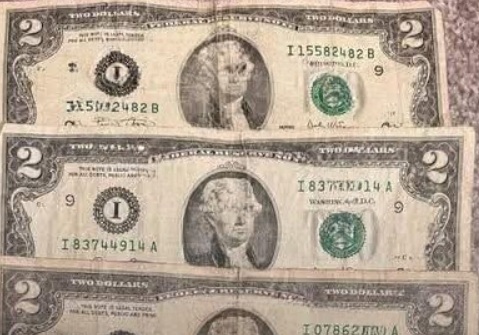
Look at the Serial Number
Serial numbers are one of the most exciting aspects for collectors. A bill with an unusual serial number can be worth far more than its face value.
Examples include:
Low serial numbers (e.g., 00000025)
Repeating numbers (e.g., 77777777)
Ladder patterns (e.g., 12345678)
Radar numbers (e.g., 12344321)
Solid numbers (e.g., 55555555)
These patterns are rare and highly desirable among collectors of paper currency.
Evaluate the Condition
Condition is crucial in determining value. Collectors generally categorize banknotes using a grading system similar to coins.
Typical grades include:
Poor or Good: heavily worn
Fine: moderate wear
Very Fine: minor wear
Extremely Fine: nearly new
Uncirculated: crisp with no folds
An uncirculated $2 bill with a unique serial number can sometimes sell for hundreds—or even thousands—of dollars depending on rarity.