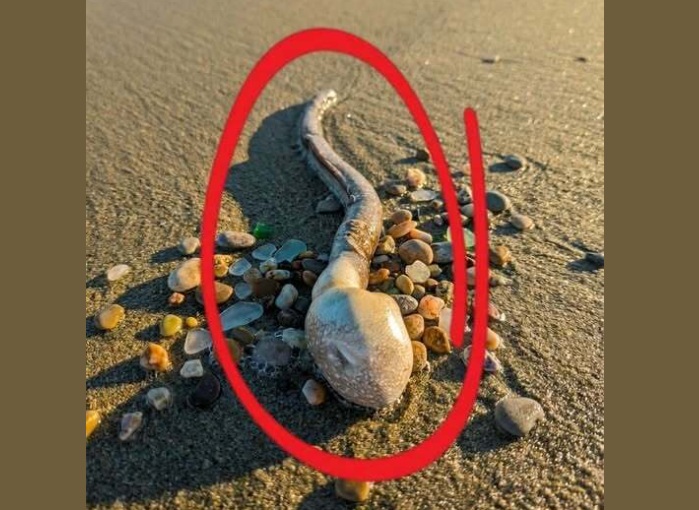
A Mysterious Beach Discovery Left Everyone Curious During a Simple Walk
What began as a completely ordinary walk along the beach quickly turned into an unexpected mystery. A person and their dog were enjoying a peaceful stroll near the shoreline when something unusual caught their attention in the sand. At first glance, it looked unfamiliar and out of place, immediately sparking curiosity.
Naturally, they stopped to take a closer look.
The object didn’t resemble the typical shells, driftwood, seaweed, or stones commonly found near the water. Its shape, color, and texture were unlike anything they had encountered before, making it difficult to identify at first glance. They examined it carefully from all angles, trying to make sense of what it could be, yet the mystery only deepened.
As often happens with strange discoveries, curiosity soon gave way to questions. Was it something natural? A marine organism? Part of an old machine? A rare shell or fossil? Or had the ocean somehow carried it ashore from a distant location?
Beaches Are Natural Collecting Grounds
Moments like this are surprisingly common near oceans, lakes, and rivers. Beaches are dynamic, ever-changing environments where waves, storms, tides, and currents continuously move materials from one place to another. The constant motion makes it easy for unusual objects to appear seemingly out of nowhere, and many beachgoers encounter items they never expected to find.
Shorelines act as natural collection zones. Over time, the ocean deposits seashells, driftwood, coral fragments, sea glass, fossils, and marine plants onto the sand. Fishing gear, parts of boats, and other human-made objects can also wash ashore, sometimes heavily weathered and unrecognizable. Occasionally, even stranger objects arrive, leaving beach visitors completely puzzled.
Storms and changing tides can uncover items that have remained hidden for years. Currents and winds transport objects across vast distances, meaning something discovered in one location could have traveled hundreds of miles before arriving.
Beachgoers might theorize that the find is a rare marine organism, a fossil, part of a sunken ship, a weathered natural formation, or an unusual shell shaped by erosion and time. Even when the mystery turns out to have a simple explanation, the intrigue it creates is often more memorable than the answer itself.
Nature Shapes the Unexpected
One reason beach finds can be so hard to identify is that nature constantly alters objects. Erosion, saltwater, sunlight, and movement transform familiar items over time. Waves smooth rough edges, sand reshapes surfaces, and ocean currents can polish or fracture objects. Driftwood twists into abstract forms, rocks develop unusual patterns, and shells break into shapes that seem almost alien. Even man-made items can become completely unrecognizable after months or years in the sea.
Dogs Often Lead the Way
Interestingly, pets often play a key role in beach discoveries. Dogs, naturally curious, investigate unfamiliar smells and textures long before humans notice them. They frequently lead their owners to hidden shells, buried objects, piles of driftwood, washed-up debris, or even tracks left by wildlife. In this way, pets can turn ordinary walks into memorable adventures, uncovering surprises that might otherwise remain unnoticed.
The Internet and Beach Mysteries
In recent years, mysterious beach finds have become popular online. People love posting photos of unusual objects and asking others to help identify them. Such posts often attract hundreds or thousands of responses, with guesses ranging from scientific explanations to imaginative, humorous theories. Common suggestions include rare sea creatures, fossils, ancient artifacts, marine equipment, weathered bones, or volcanic rocks. Even experts sometimes disagree when objects have been heavily altered by the elements.
The Science Behind Coastal Change
Beaches are constantly shaped by natural forces. Wind, waves, tides, and salt gradually alter materials exposed to the environment. Sharp edges become smooth, colors fade, surfaces crack or polish, and organic matter decomposes. Because of these transformations, even familiar objects can look entirely new or unrecognizable when washed ashore.
Some Discoveries Are Surprisingly Ordinary
Despite initial intrigue, many mysterious finds eventually have simple explanations. They may turn out to be weathered fishing gear, driftwood, sea-worn plastic, fragments of coral or shell, or parts of old marine equipment. Yet even when the explanation is straightforward, the thrill of the unknown is what makes these moments memorable.
The Excitement of the Unknown
Part of the appeal of beach discoveries lies in the uncertainty. Humans naturally enjoy solving puzzles. A strange object creates questions: Where did it come from? How long has it been here? Is it natural or man-made? Has anyone else seen something like it? This curiosity drives conversations, fosters imagination, and inspires exploration.
Beaches Encourage Exploration
The constantly shifting shoreline ensures no two beach visits are alike. Depending on tides, weather, and season, visitors might discover unique shells, sea glass, smooth stones, interesting driftwood, tide pools, unusual marine life, or naturally sculpted sand patterns. This unpredictability keeps walks exciting, peaceful, and educational at the same time.
Safety First
Although most beach discoveries are harmless, experts recommend caution when handling unknown objects. Some may have sharp edges, fragile surfaces, marine bacteria, chemical residues, or hidden creatures. When in doubt, it’s best to avoid direct contact until identification is possible.
Final Thoughts
What started as a routine beach walk quickly became an intriguing mystery after a strange object appeared near the water. Despite close examination, its identity remained unclear, sparking curiosity and conversation. Beaches, constantly reshaped by tides, currents, and storms, regularly reveal unexpected items—from natural formations to weathered debris—that can baffle even experienced visitors.
Ultimately, the real excitement lies not just in identifying the object but in the sense of wonder it inspires. These small, surprising moments remind us that even familiar places can hold secrets waiting to be uncovered. Whether the find turns out to be rare, natural, or ordinary, it is the curiosity and shared fascination that make the discovery truly memorable.