I Found This Strange Brown Object in My Girlfriend’s Bathroom — Here’s What It Turned Out to Be (And Why It’s Probably Not What You Think)
I stood in the doorway of my girlfriend’s bathroom longer than I care to admit, just staring.
At first, I didn’t even fully register what I was looking at. It was one of those moments where your brain pauses—not out of confusion exactly, but out of hesitation. Like it’s trying to decide whether something is important enough to process.
Then it hit me.
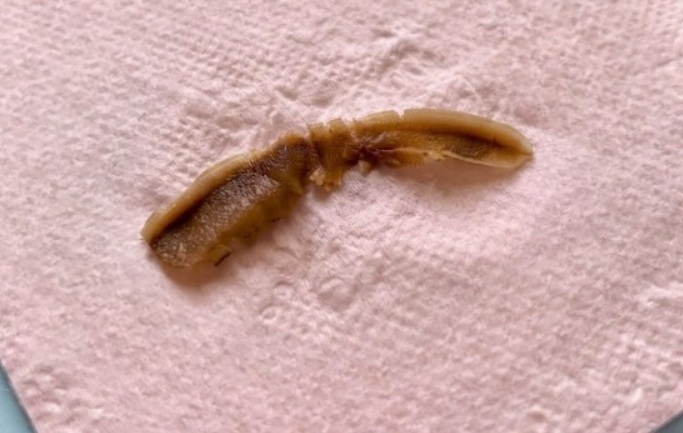
On the edge of the sink, sitting on a neatly folded piece of tissue, was a small brown object. It had an odd shape—slightly curved, uneven, with what looked like faint segments running along its length. The surface caught the light in a way that made it seem almost glossy.
And just like that, my mind started racing.
It didn’t look like anything I recognized.
And when something unfamiliar appears in a place as personal and everyday as a bathroom, your imagination tends to fill in the gaps—usually with the least comforting explanations possible.
The Spiral of First Impressions
At first glance, I thought it might be something alive.
Or something that used to be.
It had that organic look—soft edges, irregular form, a kind of natural asymmetry that made it feel biological. Not mechanical. Not manufactured. Something that came from somewhere.
That’s where the unease started.
Because when something looks organic but unfamiliar, your brain doesn’t default to harmless explanations. It jumps straight to questions like:
Is this some kind of insect?
Did it come from the body?
Is it something I should be worried about?
I didn’t touch it. I didn’t move it. I just stood there, analyzing every detail like I was trying to solve a puzzle I hadn’t asked for.
After about an hour of overthinking, I realized something important:
The object itself wasn’t the real problem.
My interpretation of it was.
Why Unfamiliar Objects Feel So Unsettling
There’s a reason moments like this feel disproportionate to what’s actually happening.
When we see something out of context—especially something that looks biological—our brains go into a kind of protective mode. It’s a built-in response. We’re wired to notice irregularities, particularly ones that might signal danger.
But here’s the catch:
That response is based on appearance, not reality.
A segmented shape doesn’t automatically mean insect. A glossy surface doesn’t automatically mean something alive. And an unfamiliar object doesn’t automatically mean something is wrong.
In fact, most of the time, it’s the opposite.
Looking at It More Rationally
Once I stepped back (literally and mentally), I started to break it down more logically.
What did I actually know?
It was small
Brown in color
Slightly segmented in appearance
Resting on tissue, as if someone had already removed it from somewhere
Located in a bathroom—not exactly a place where random biological hazards usually appear without explanation
That last detail mattered more than I initially realized.
Because bathrooms are full of everyday items that, when removed from their normal context, can look surprisingly strange.
The Most Likely Explanations
Once I stopped assuming the worst, a few much more realistic possibilities came into focus.
1. A Piece of Food (Yes, Really)
It might sound odd at first, but this is one of the most common explanations for objects like this.
Cooked food—especially certain types of meat or seafood—can take on very unusual shapes once broken apart.
Think about it:
Cooked chicken can appear fibrous and uneven
Shrimp or other seafood can have natural segmentation
Oils can create a glossy sheen
Browning from heat can deepen the color
If a small fragment ended up somewhere unexpected—say, transferred from a plate, clothing, or even hands—it could easily look unfamiliar outside its normal setting.
What looks strange in a bathroom might look completely ordinary on a dinner plate.
2. A Fragment of an Insect
This was one of my initial thoughts—and while it sounds unsettling, it’s not necessarily alarming.
Insects are part of everyday environments. Even in clean homes, they exist in small numbers.
Sometimes:
A leg, wing, or body segment becomes separated
A dried fragment ends up in an unexpected place
What remains looks nothing like a whole insect
The key point is this: a single fragment doesn’t indicate a larger issue.